Sunday, October 3, 2010

A day on the river

You are a geologist when you have fun digging trenches to see cross-bedding and when you enjoy photographing mud clasts on a Saturday afternoon.
©RomaniaRocks

I am a geologist, so is my SO, and this weekend we enjoyed a trip along the Trinity River; beautiful weather was a plus, and it made it for a great family outing.  We started with our canoe from the bridge across Trinity near Liberty, TX.  From here we went north for about 7 km in total (the red line shows our path for the day).
The first stop was on the opposite bank from the meander loop cut-off, indicated by the yellow arrow in the picture above.  A point bar with a lot of awesome features, worthy of any Geology 101 class: ripples and dunes...
©RomaniaRocks
... with awesome lineation in the coarse grain fraction oriented parallel to the transport direction (downstream is towards the top of the picture).
More ripples and dunes...
©RomaniaRocks
... mud cracks and the resulting mud-chips waiting for the next bank-full discharge to be washed away....
©RomaniaRocks
... unless of course your teenager will not remove them all by building mud-chip castles.
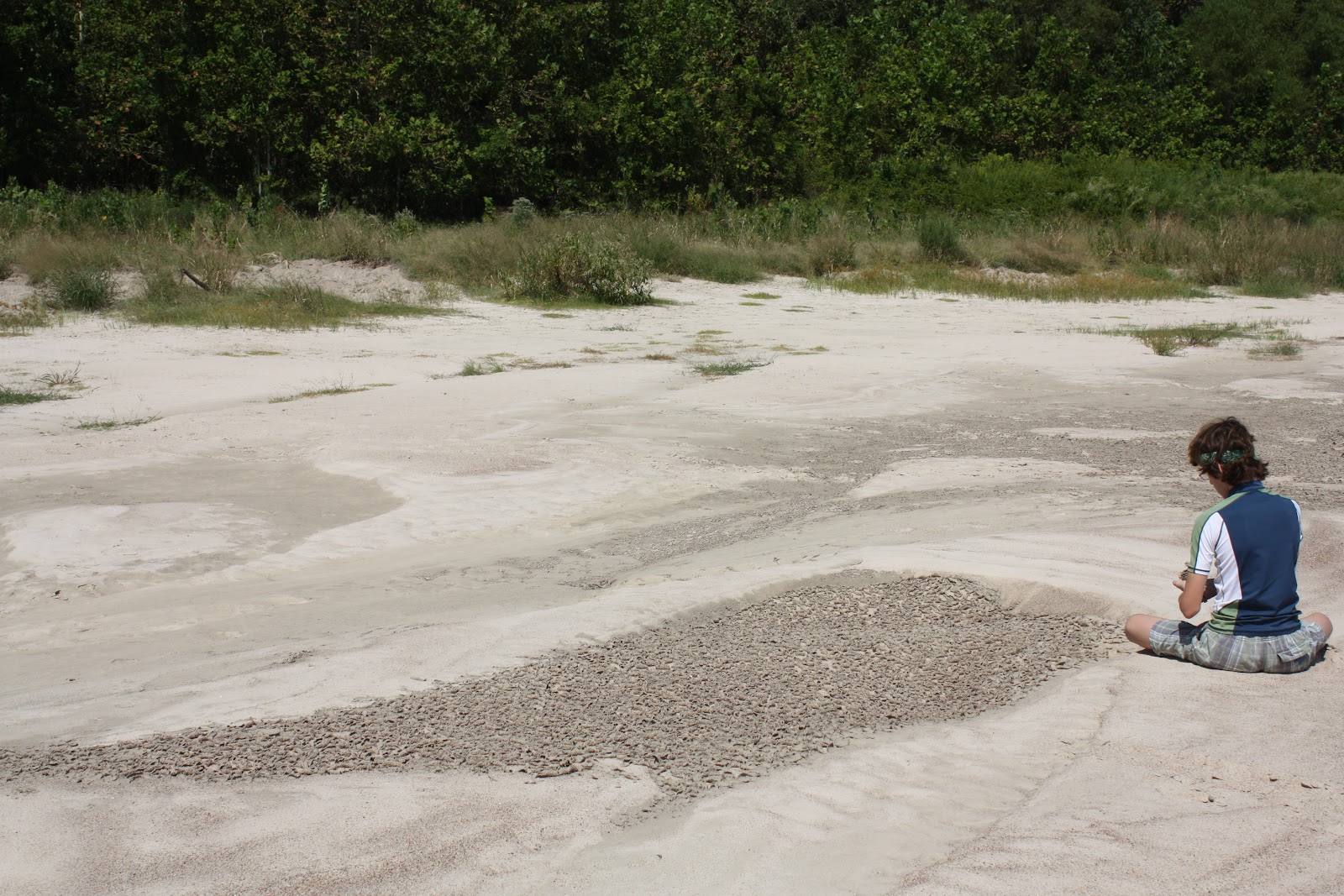
©RomaniaRocks

The mud cracks on the surface of this point bar developed in low areas, when water level was just above the edge of the depression where the mud accumulated.  Eddies formed in these low areas of the point bar, and these eddies brought in and deposited a thin layer of mud.  The mud cracks formed later after the water receded and the surface dried out.  Similar eddies carrying and depositing fine-grained material (but at a larger scale) were responsible for the deposition of a nice mud-drape on one of the point bars we stopped at further upstream.  The picture below shows the river bank with the water flow from right to left, and a protected area entered by an eddie, which deposited a beautiful mud-drape over the extent of the point bar exposure (arrows indicate the extent of the mud drape).
©RomaniaRocks

Well developed cross-bedding may be seen within the point bar succession....
©RomaniaRocks
... and ripple lamination, cross-bedding and wind ripples may be found in the right exposures on the point bars...
©RomaniaRocks
We had a blast: great weather, nice river, good canoeing, and cool sedimentary features.  You get the picture :)
Enhanced by Zemanta

Comparative geology - the tale of two rivers

I recently went on a canoe trip along the Trinity River (our track is shown by the red snaky line in the picture below).  We spent the day looking at sedimentary features associated with modern river systems, and by doing so, thinking about processes at work in rivers, and the resulting rock architecture.  As geologists, we often study modern environments (like rivers, beaches, deltas etc) to gather clues that help us understand the rocks and the processes that formed them.

The trip to the Trinity (more details in this post) reminded me of the Arges River in Romania; if looked from above, both have a lot in common.
Note that the scale of the two satellite images are similar, so the size of the geomorphic features can be easily compared.  The width of the meander belt in the two images is similar.  Two abandoned meander loops (red arrows) have similar dimensions and shape.  Their paleo meander belts (active sometime in the recent past and still visible on the satellite image) have similar widths (black arrows).
The zoomed satellite photos show that the size of the active channels are similar.  The Arges shows better the point bars within the active channel, but this is only because the picture of the Trinity was taken at near bank-full stage, where most of the point-bars are submerged.
These two rivers, although in somewhat different settings, would most likely create a very similar rock succession.  I have to take a canoe trip along Arges sometime in the future, and at that point I will have on the ground pictures from the both locations.  Until then, wait for the next post on the Trinity, and enjoy the birds-eye view of the two rivers.

Monday, September 27, 2010

Landscapes into Rock - Part 3

This post continues my summary of the Landscapes into Rock conference that took place in London, September 21-23, 2010.  Click here for previous posts.

The second theme of the conference – The Dynamics of the Sediment Routing System – was chaired by Alex Densmore (Durham University) and Ruth Robinson (University of St. Andrews), who assembled a very good mix of nine talks and three keynote speakers: James Syvitski (University of Colorado), Greg Tucker (University of Colorado) and Chris Paola (University of Minesota).

Interesting research of the Golo source-to-sink system was presented by Tor Somme (University of Bergen) et al.  One of the interesting conclusions was that channel aggradation may occur both during eustatic highstand and lowstand, and that sediment partitioning along the source to sink continuum may be controlled by internal thresholds rather than external forcing.

 The keynote by Greg Tucker (University of Colorado) on rapidly changing landscapes underscored some interesting points:

  • channel incision rate correlates with characteristic stream power and shear stress;
  • temporal variability in sediment cover is an important control in long-term bedrock river incision.

Chris Paola’s keynote address on mass balance effects in depositional systems was full of insight, discussing many fascinating concepts:

  • fractional sediment extraction and the subsidence-driven depositional mass loss 
  • similarity in fining profiles along depositional trends
  • the use of generalized models/experiments as reference cases of down transport changes, against which field or subsurface cases can be compared
For the benefit of advancing our knowledge and workflows Chris jokingly invoked the need for adhering to the “Republic of Simplicity”, which created a cascade of comments in almost every talk that followed. Others, in return, advocated the “Republic of Complexity” or the “Monarchy of Necesity”, leading to great discussions but also polarized opinions among two camps: those who view the need to approach the Earth’s dynamic systems in all of their complexity, and those who believe that a simplifying approach maybe more appropriate. I certainly subscribe to the simplicity theory, while I choose to remain a citizen of the world and not subscribe to any republic or monarchy :)

Sunday, September 26, 2010

Random fluid dynamics thoughts (and videos)

I was riding my bike this morning along one of the man-made drainage channels in my extended neighborhood.  Couldn't help to watch the water flow patterns and make connections between fluid dynamics and fluid/sediment flow patterns in modern environments.  The short video below shows the fluid dispersal patterns not dissimilar with what one would see in a river reaching a shoreline and changing flow from confined to unconfined on a gently dipping slope.  Note how the fluid dispersal pattern is fan-like, not different from a fan shape in a distributary channel system.  There is a sharp change in slope, about half way through the image.  Note how the dispersal pattern changes from fan-shape to almost parallel stream lines.


There was something else that caught my attention.  To the right of the location in this first video, there was a change in slope, where two concrete slabs came together at an angle.  At the same location, water was flowing from two directions, the stream lines joining at almost 90deg angle.

This caused the flow to have its top surface split in two.  Are these standing waves?  What else are they called and what causes their formation?  The change in slope? Flow directions joining at 90deg angle? A combination of both?  Watch the video and let me know.

Saturday, September 25, 2010

Landscapes into Rock - Part 2

The Landscapes into Rock conference held in London this past week had four main themes.  For more general information about the event, see my previous posts.

The first conference theme was "The Erosional Engine". The session was chaired by Alex Whittaker (Imperial College London) and Andrew Carter (Birkbeck College London) and focused on geomorphology, erosion, sediment flux, burial/exhumation histories. The theme had eight contributions in the form of presentations and two keynote speakers: Niels Hovius from University of Cambridge and Kelin Whipple from University of Arizona.  Several posters were also on display.

One of the highlights for me was the talk by Paul Bierman et al (University of Vermont) on their synthesis of the ten-year research in erosion and sediment rates using cosmogenic nuclides, with one big takeaway being the fact that bedrock erosion rates (measured from outcrop along ridgelines) are slower than basin-scale erosion rates inferred from fluvial sediment; the latter integrates processes active across the entire landscapes. Interesting also was the positive correlation between tectonic setting/activity and erosion rates and the documentation of using cosmogenic nuclides as tracers to study processes over 10 to 10^5 years timescale.

The keynote address by Niels Hovius on weathering, erosion and sediment transfer in Taiwan, was another highlight, with a valuable insight into the fact that to get a better understanding of weathering and erosion it is more useful to look at the dynamic forces acting upon a landscape (tectonics, erosion, climate), rather than at the static proxies such as topography or landscape.  Both Niels and Paul referred to mountains as being “big piles of sand”, which stirred a big debate during the discussion sessions.

Kelin Whipple’s keynote talk on tectonic and climatic control on erosion rates made some excellent points: at steady state conditions, tectonic is the major control on erosion (not climate). For non-steady state conditions, some generalizations arise regarding the ability to distinguish between the tectonic or climatic forcing, with erosion rates increasing gradually in response to tectonic forcing, versus erosion rates increasing immediately in response to climate forcing.

Friday, September 24, 2010

Landscapes into Rock - Part 1

Landscape into Rock conference, held in London during 21-23 September, was an extremely insightful event, rich in ideas and very inspiring. The title itself is meant to represent many aspects of sedimentary geology: 
  • the link between surface geologic processes and the resulting rocks; 
  • the source-to-sink continuum of sedimentary processes and depositional systems, and the need to understand and view this continuum with a holistic approach; 
  • the insights that can be captured from short term processes, rates and models and how these insights may be applied to the rock record, which represents a much longer time frame and records controlling factors and rates that may have been very different compared to what we observe today; 
  • what makes stratigraphy and how do we place stratigraphy in the context of Earth’s dynamic systems.

The organizers were Philip Allen (Imperial College London), Paul Bishop (University of Glasgow), Hugh Sinclair (University of Edinburgh) and Robert Gawthorpe (University of Bergen).  Through careful planning at many levels they made this conference a success.  The event was held at the Burlington House on Picadilly Street.
© RomaniaRocks

The conference was held as one plenary session, which for me was great: more focused and less stressful compared to large conferences with many synchronous sessions, which leads to the desire to clone oneself in order to be able to be in several places at once in order to not miss relevant talks.
The talks and posters were grouped in four themes, which took place in succession over the three days.  I will cover each theme in a separate blog post (to come over the next few days).  Needless to say, I was unable to tweet or blog real time, as internet connection costs an arm and a leg in London.
One side note: during the event, Paul Bierman made everyone aware of the digital archive of Earth surface images that is under development at the University of Vermont. This is a NSF-supported, free archive useful for teaching and learning about geomprphology - enjoy!.

Friday, September 17, 2010

Using crowds to communicate and innovate

Three pieces of information came together today, they merged and managed to spark some ideas in my prefrontal cortex.  First, a note from the organizers of "Landscapes into rocks" conference, which I will attend next week, asking for my permission to record the talk and post it online.  This took me by surprise, and of course the first thought was "what a nice and progressive idea".  Followed by the next thought "what if I have a stomach ache and give a lousy talk? It will remain forever posted on the web,  and I will be forever embarrassed!  I better prepare!"
Then, I stumbled upon a blog post by Seth Godin with an insightful title - "Rehearsing is for cowards", where the basic idea is that a well rehearsed talk/presentation will protect  "against the downside, the unpredictable and the embarrassing" but will not allow for a potential leap forward. Seth states in his post:
"A well-rehearsed performance will go without a hitch. An explorer seeks the hitches, because hitches are the fissures and chasms that help us leap forward."
The third and final piece that made my day was a TED talk by Chris Anderson on Crowd accelerated innovation.  This talk emphasized how internet video allows the communication of ideas beyond the audience that attended an event, and also how it creates a cycle of improvement, through the feedback and the recognition a video post receives.
Related Posts Plugin for WordPress, Blogger...