Sunday, July 25, 2010

Update on the Black Sea earthquakes

Since my post this morning about the three earthquakes in the Ukraine side of the Black Sea, one more happened today at 16:10:56 (UTC).

Here is the map with all four events:

I also found a tectonic map with the major fault zones at the end Jurassic (after Robinson et al, 1997), that may shed some light regarding the seismicity in the Black Sea.  It appears that the lone event is related to a fault zone bounding the Shatsky Ridge in the eastern Black Sea, and the three clustered ones SW of Sevastopol are near the Jurassic tectonic boundary of the Tavrik-Kure basin.

Low magnitude earthquakes are not uncommon in the Black Sea.  Below is a list of all the 2010 seismic events with a magnitude greater than 2 on the Richter scale (from the National Institute of Earth Physics, Romania):

Black Sea Earthquakes


On Saturday, three earthquakes in the Black Sea succeeded over an interval of five minutes.

The first was located west of Sevastopol and occurred at 18:51 (UTC).

The second took place SE of Sevastopol at 18:55:24 (UTC).

The third earthquake was located very close to the first, about 64km W of Sevastopol, and occurred at 18:55:52 (UTC).  The four maps above are courtesy of the National Institute for Earth Physics in Romania.
I do not know much about the earthquakes in the Black Sea, since the big events in Romania are related to the Vrancea region (see my previous post here on the geology and wine - seismic terroir).  I will try to find out more about the focal mechanism and other information, but if any of you know more, please leave comments.  

From information I found on EarthquakeDB, in 103 A.D an earthquake in Ukraine (map below) associated with a Tsunami had the epicenter located very close to the ones that occurred yesterday.  Fortunately, no Tsunami on Saturday!

Saturday, July 24, 2010

Trip to the past

I recently returned from a trip to Romania, in Zarnesti-Bran-Piatra Craiului area; this was a trip to the past in a couple of ways: my past, and the geologic past.
Twenty-some years ago I was an aspiring geologist, and while I was waiting to find out if I made it into the Geological Sciences School at the University of Bucharest, I went with a group of friends on the week-long trip to the Piatra Craiului Mountains.  We had a great time and I have great memories, so this year I decided to retrace some of my steps of many years ago.
© RomaniaRocks
We accessed the trails from our home-base in Zarnesti, you can see the town in the distance in this picture.  I took it from the hiking trail  leading to Curmatura cabin, the placed my friends and I used as our base camp on our vacation from the past.  The picture is looking towards ESE, and in it you can also see the Barsa Mare River and, in the distance, the Southern Carpathians.
Piatra Craiului is a spectacular mountain range, its crest is about 25 km long (Google map in my previous post), and it owes its beauty to geology.


© RomaniaRocks
And here comes the trip to the geologic past.  The mountains consist primarily of Jurassic and Cretaceous limestone, with the entire section about 1050 m thick.  The lower 500m consist of a carbonate breccia and conglomerate sourced from Late Jurassic reefs located to the south, in the area of today's Bucegi Mountains.  The rest of the section consists of reef carbonates and these are the rocks that give the area its beauty.  The picture above shows the western versant of the Piatra Craiului and is taken from the Plaiul Foii Chalet , the place where we will stay for sure on our next trip here.
© RomaniaRocks
The mountains  are a dream for spelunking, rock climbing, hiking, or just hanging out.  Dambovicioara Gorge (shown in the picture to the left), a 2 km spectacular narrow, v-shaped canyon with steep sides, is another attraction.
We returned home from the trip to the past driving through the Rucar-Bran corridor.  It was a rainy day, with heavy fog at times, which made the picture taking not an easy task, but the image below gives a good idea of the natural beauty of the area.
Piatra Craiului became a National Park in 1938; a nice post about the park, with info and pictures, came out recently in the True Romania blog here.
© RomaniaRocks
Enhanced by Zemanta

Sunday, June 6, 2010

Trip to the Mesozoic

This summer we are going to Romania to visit family and friends and are planning a trip to the Piatra Craiului Mountains.  We will spend at least a couple of days hiking the Mesozoic reef buildups in the area, and will enjoy some of the most amazing scenery in the Southern Carpathians.  Our first excursion will most likely be on the Northern side of the mountains, from the town of Zarnesti (link in Romanian) to Turnu and Padina Popii Peaks via Padina Hotarului.  A fun hike with about 1200m of elevation gain.

Sunday, May 23, 2010

The invisible oil spill

I am a geoscientist and the Earth is not only my home, but also my passion and my profession. The oil spill in the Gulf of Mexico saddens and troubles me deeply. Much has been talked, published and blogged about it, so I will not discuss it here. Instead, I would like to talk about the "invisible oil spill", which is happening every day, ever since oil was discovered. This is the oil that you and I consume daily, and in every way it is the fundamental reason we have an oil spill in the Gulf today.  Bare with me through this simple calculation.

I drive to work about 20 days every month (some days I bike to work), which makes about 240 days/year. My car gets about 25mi/gal. If, on average, one barrel of crude yields 19.5 gallons of gasoline, and if my math is correct, in 16.25 days my car consumes one barrel of crude just by driving to work, and every year I use 14.8 bbl of oil, just to drive to work.  Another way to look at this - I "spill" about 15 gallons every year just by driving my car to work - an invisible spill, but one that is real.

The US oil consumption is estimated at about 19 million barrels/day, so WE collectively "spill" millions of barrels every day.  This is a complex issue; petroleum (and coal) fuel the world's economy, and through that, contributed to the progress of the human civilization as we know it.  We humans, collectively, have the responsibility to find a sustainable path that will take the civilization forward and be sensitive to the planet in the same time.  The blame game is never very effective.  One cannot point fingers and roll up the sleeves in the same time.

Sunday, April 18, 2010

Volcanoes -- modern and ancient

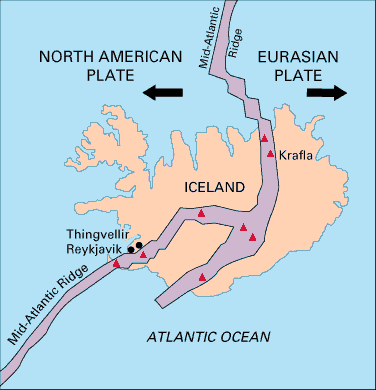
The recent eruption of the Eyjafjallajökull Volcano in Iceland made a lot of press lately and captured the interest of scientists and non-technical folks alike.  In this post I want to compare and contrast the modern volcanism in Iceland with the Neogene-Quaternary volcanic setting in Romania and, in doing so, to briefly review two different tectonic settings in which volcanic activity may take place.

Iceland is located at a divergent plate boundary over the Mid-Atlantic Ridge, along which the North American Plate and Eurasian Plate are being pushed apart by newly formed crust (diagram below from USGS Credit: U.S. Geological Survey Department of the Interior/USGS)

A deep-seated mantle plume is also present in the area and interacts with the North American Plate.  This plume (or hotspot) and the active spreading axes are producing the volcanism of present day Iceland. The map below (from R.G. Trønnes, Nordic volcanological Institute, University of Iceland) shows both the active and old spreading axes as well as the position of the mantle plume between present day and 40 million years ago.


The ash cloud from the icelandic volcanic eruption was observed in the Northern part of Romania on April 16 and 17, but Romania had ash produced from its own volcanoes as recently as 10,000 years ago.  In contrast to Iceland, the Romanian volcanoes were active at a convergent plate margin.  The resulting volcanic arc deposits are Neogene to Quaternary in age and are located in the Northern part of the Eastern Carpathian mountains.  The map below (from A. Szakracs,I. Seghedi, 1995) shows the volcanic cones and the associated deposits in Calimani-Gurghiu-Hargita mountains.


The Eastern Carpathians volcanic arc is 160km long, the longest in the entire Carpathian mountain belt.  It formed as a result of the convergence between two plate fragments, the Transylvanian micro-plate and the Eurasian plate.  The volcanic activity spanned from ~15 Ma to 0.01 Ma ago.  The area is interesting not only from the geological point of view, but also for its natural beauty, but about this in another post.

Wednesday, April 14, 2010

Free books and ... geology of course

I was driving back home from the office today listening to NPR, and Andrei Codrescu's commentary "Getting From Here to There"  inspired me in many ways.  His story also pointed me to an iPhone app "FreeBooks", which I immediately searched for and downloaded when I arrived home.  The app is advertised as "23,469 classics for less than a cup of coffee" and I can tell that it will become one of my favorite apps.  It will take me a while to read all of this good stuff, but for sure among the first will be the "geology-flavored" books.  Here are some of them, now accessible anytime from my trusty iPhone (if I would only have more than 24h in a day):

  • The Student's Elements of Geology - by Charles Lyell (1870)
  • Geological Observations on South America - by Charles Darwin (1846)
  • Geological Observations of Volcanic Islands - by Charles Darwin (1844)
  • Geological Contemporaneity and Persistent Types of life - by Thomas H. Huxley (1862)
  • The Economic Aspects of Geology - by C.K. Leith (1921)
  • Discourses: Biological and Geological Essays - by Thomas Henry Huxley (1894)
  • Town Geology - by Charles Kingsley (1871)
  • The Boy Scouts of the Geological Survey - by Robert Shaler
So, drink one less cup of coffee, relax with a good ole book and be happy!
Related Posts Plugin for WordPress, Blogger...